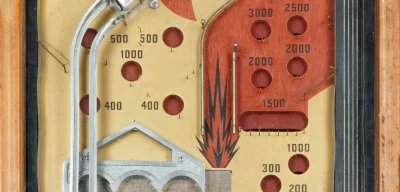
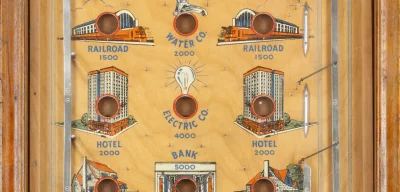
Zephyr Preview Image
Machine Description
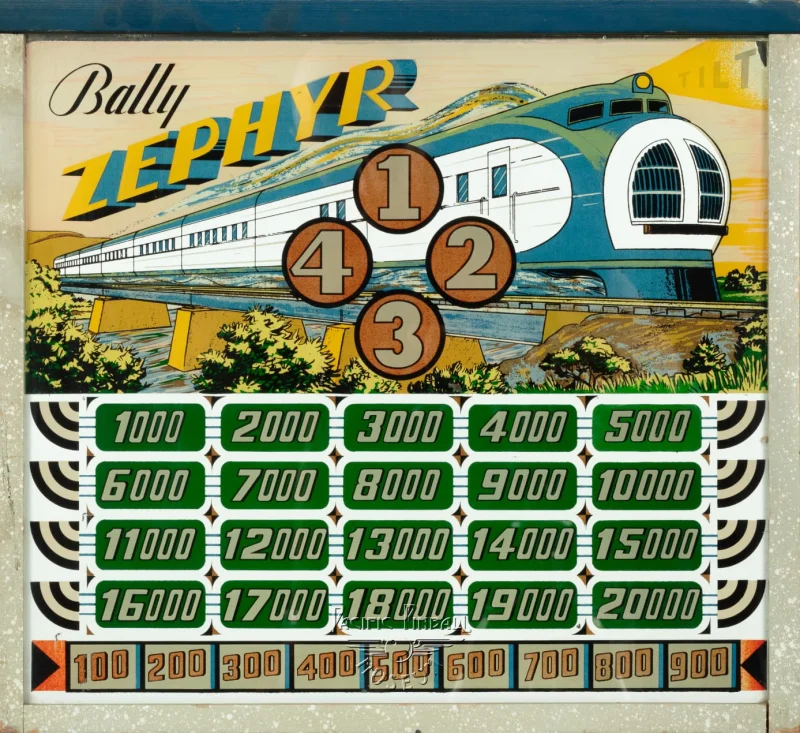
1938 Bally Zephyr Backglass. Silk Screened glass, 22” X 20”.
Artist; presumed to be George Molentin, working for Advertising Posters.
Although the name Zephyr conjures up exotic visions of the romantic age of streamliners, the train on this 1938 Bally Backglass is indeed not the Zephyr, but rather an M-10000, a Union Pacific which was the 2nd Petrol- Electric Streamliner. George Molentin, the assumed artist at Advertising Posters, who created the backglass and playfield art may have had aesthetic reasons for substituting this train for the Zephyr. The M-10000 may have a clunkier name but it is far smoother in appearance.
The Zephyr had quite the history behind it, so it ultimately didn’t matter, the name alone was enough to instill a certain amount of awe in 1938. The Zephyr was one of those phenomena that happens at the right time cementing its place in history and popular lore. It was 1933 and the passenger rail service was taking a beating from the depression, they needed something lighter, more efficient and affordable to operate. So American ingenuity came together and created new techniques for welding stainless steel, a new locomotive system; diesel-electric to replace the heavy, archaic steam engines and a new design, the streamliner, to give it a fresh modern look that would inspire ridership. Introduced in April 1934, the train set a world speed record by May 26th hitting 112.5 MPH in a world-famous Denver to Chicago run. It was featured prominently as a byproduct of the Chicago ’33 ’34 World’s Fair, A century of Progress. Hollywood wasted no time basing the film “Silver Streak” on it loosely and releasing it by Dec that same year. The Zephyr was used in all sorts of advertising and eventually, by 1938, made its way onto a pinball machine. The original restored Pioneer Zephyr is on display in Chicago at the Museum of Science and Industry. Truly a success from the 1930’s.
-Michael Schiess