Ritz Preview Image
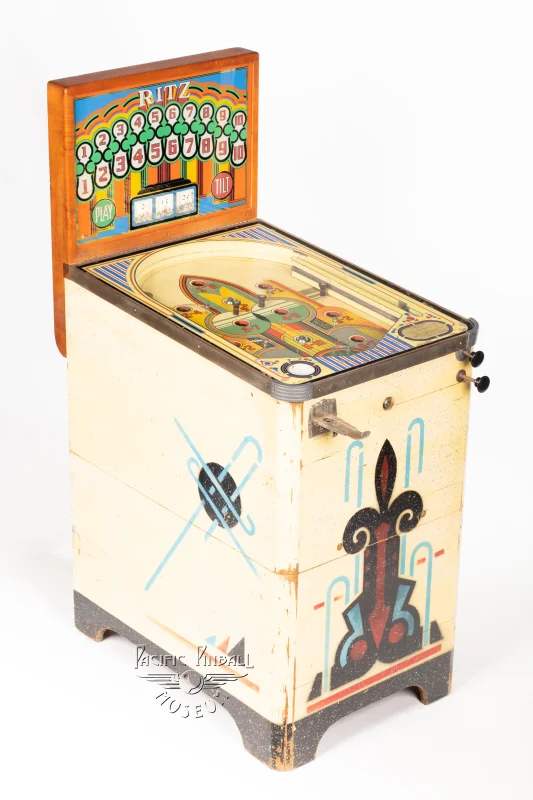
Machine Description
Ritz, released by Stoner Mfg. in 1938, designed by Harry Stoner and Karl Knickerbocker, art attributed to Roy Parker.
This article is one of the first by Michael Sands of http://sandsmuseum.com/
The article pertains to the Ritz donated by Michael Sands to the Pacific Pinball Museum.
Ritz is one of the most beautiful, unique, unusual pinball machines I have ever seen. It is also one of the most boring. It is simple mechanically and has several interesting features.
Ritz was built by the Stoner Manufacturing Company in October of 1938, according to the Pinball Reference Guide by Mueting and Hawkins. This particular game was serial number 122 and was first operated by Stewart Sales Company, 15 E. Bijou Street, Colorado Springs, Colorado. It appears to be a gambling machine with many of the same features of a bingo. Just above the out hole the manufacturer is identified as:
Stoner Mfg. Corp. - Aurora, Ill.
Made in United States of America
Pat. No. 2,093,293
Other Patents Pending
Description
There are three odds windows and a tilt light besides the two rows of numbers in the back glass. The machine has five balls and uses the normal push rod ball lift mechanism. There is a ? hole and the machine will spot a random number if the ball enters this hole. The Ritz in the back glass lights up if the user is a winner, a signal to the keeper of the establishment that the player should be paid according to the lit odds window.
One of the most unique features of this machine is the cabinet design. It is built like a console and has no legs. The cabinet actually is in two pieces. The normal box is supported by a skirt. The skirt can be removed and the box placed on a table or other support. The game looks like a single unit when placed on the skirt as the seam is almost not noticeable and the art work flows from one to the other. The art work is the best of the art deco era with wonderful curves and out lined colors, bright red, green, yellow, orange, and blue. Even the glass covering the play field has been painted on the underside and the play field with the glass covering tilts up to provide access to the internal mechanisms.
The instruction card reads:
INSTRUCTIONS
5 Balls 5 cents
Insert coin, then shoot with skill to match the three (3) selections on back glass.
Matching three selections entitles player to points shown.
Lighting all lights (1 to 10 inclusive) entitles player to highest points shown in addition to intermediate points scored.
Hole designated by (?) is a mystery hole.
Points can be increased only by consecutive winners.
It is interesting to note the terminology. The machine awards "points" and does not explicitly talk about payouts. Yet the words on the meters inside the machine have notes that tell what each meter records. The terms talk about "payouts" for each position of odds on the back glass.
Play seems easy at first glance. The player puts in a nickel and pushes in the coin slide. The balls on the play field drop through holes and a whirring noise comes from the inside of the machine. The holes in the play field are blocked as the coin slide returns to the starting position. The numbers on the back glass flash in random order and suddenly settle with three of them lit. One of the odds lights in the center bottom is also lit. The whirring continues as there is a mechanical timer that allows you a maximum of five minutes to complete the game. The player can then lift and shoot the five balls in an attempt to match the numbers spotted by the game. There two rows of numbers from one to ten, the top row is the row the machine lights to provide a goal for the player to shoot for and the bottom row is lights to indicate which depressions the balls have landed in. This appears easy at first but notice the way the numbers are placed and their frequency, as shown in figure one!
There are three 4's and four 7's. There is only one 5 and one 8! It will be more difficult to match the specified three numbers if you have a 5 or an 8! Imagine how carefully you must place the balls if you want to light 1 through 10! I believe that the odds of the game are controlled by the number and location of the holes in the play field. There may be some control of the odds inside the machine, but I have not found any. There are no operator settings or plugs inside the machine. As a result, the player believes that it is necessary is to put the balls in the right depression to win and that each depression give two numbers. It looks easy! But the machine only gives certain numbers, perhaps appearing random, and some of the numbers on the field are difficult to make. There are five springs on the play field. These act like a rubber rings attached only at one end. It seems to take forever for the spring to catch a ball and rebound it in the new direction. The play is extremely slow because of the gentle springs, the minimal slant of the field, and the slow speed of the ball.
The letters "Ritz" in the back glass light up the instant the correct balls enter the depressions and the selection is matched. The user can finish shooting the last of the balls in the hopes of getting all numbers lit. There is a tilt light and this is connected to a slam switch on the front of the machine, a slam switch mounted to the bottom of the play field and to the plumb bob tilt on the mechanism board. There are notes stapled next to each slam switch that goes into great detail on adjustment. The switch on the front of the cabinet reads "The switch tilts the machine if the machine is give a sharp blow to bounce the ball back onto the playing field". The switch on the play field reads "The switch on the underside o f the overlay tilts the machine if the overlay is give a sharp blow".
The game seems to have provided a series of innovations. It is really a bingo and may be the first, predating Bally's Bright Lights by 12 years! The cabinet, with out legs, is unique. It had paint on the play field glass. It had extensive tilt and slam switches. I am not enough of an historian to determine if any of these are firsts.
Ritz has the following patent applied to the game. Patent number 2,093,293 was issued September 14, 1937 to Harry B. Stoner and Karl Knickerbocker. It consists of eight sheets of drawings and 14 sheets of text. It is fascinating reading! The drawings show a playfield layout, relay banks, ball sensing switches, kickers, and even a wiring schematic!
https://www.coinopstuff.com/manuals/stoner-turf-champs-patent-sheets.pdf
-Michael Sands 1995 http://sandsmuseum.com/