A Brief History of Pinball & Gambling
From Prohibition-era bans to flippers and a 1976 courtroom win — explore pinball's wild fight to be recognized as a game of skill.
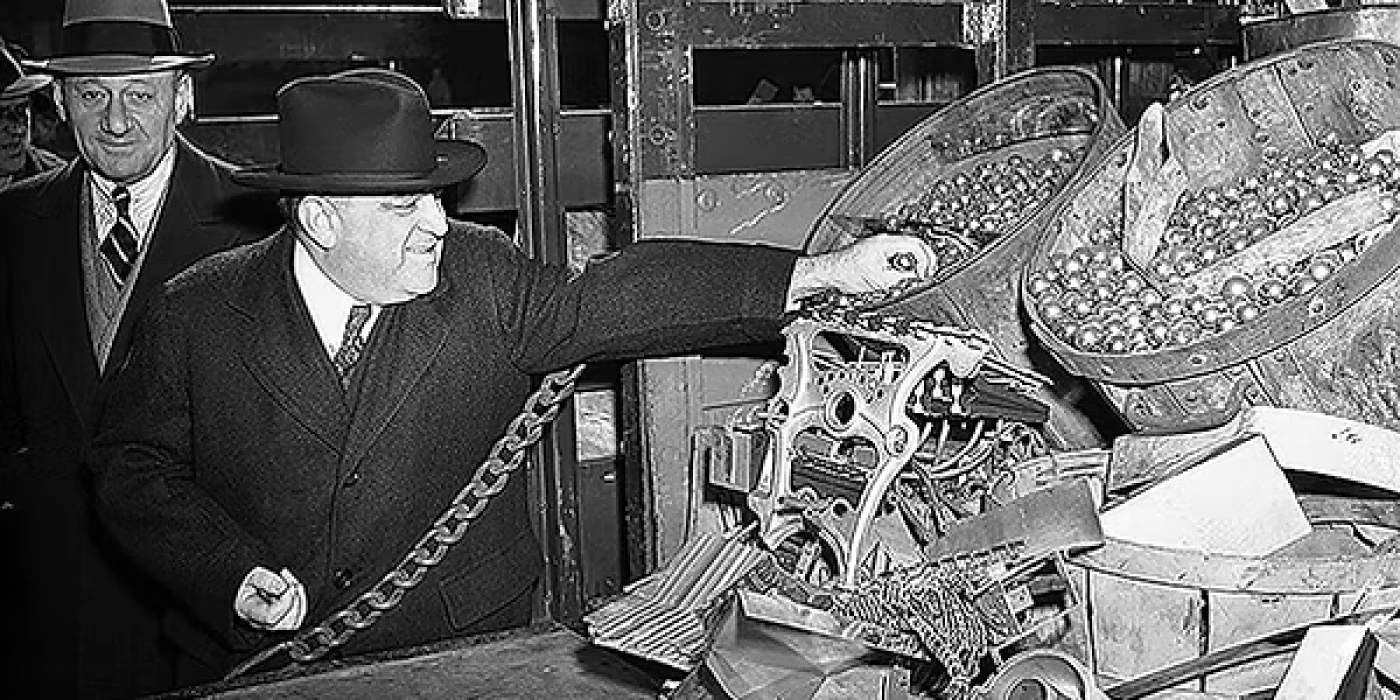
Visitors to our museum are often surprised to learn that pinball was illegal in many places for much of the 20th century. Some have heard of Roger Sharpe famously demonstrating pinball as a game of skill in front of the NY City Council in 1976, or the tales of Fiorello LaGuardia crusading against pinball during the Great Depression. Today pinball is mostly regarded as harmless entertainment or a pastime that ruled gamerooms before the rise of video games, but the story of how communities came to view pinball as a dangerous threat and the first step toward a life of gambling and vice stretches back to the birth of the game.
THE BIRTH OF PINBALL
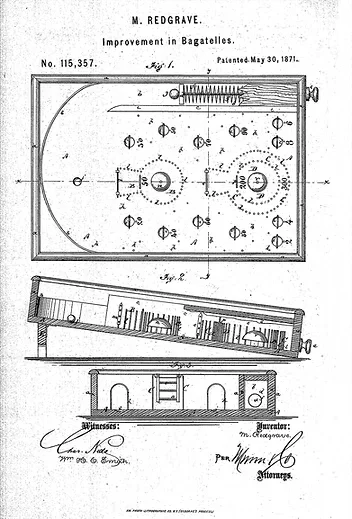
Pinball has evolved in many ways over the course of its history. Most pinball historians tie the birth of pinball with the 1871 patent for "Improvement in Bagatelle" secured by Montague Redgrave. Though that game was a condensed tabletop version of an earlier table game played with cue sticks and scoring pockets, Redgrave's game possessed the shape and key elements of a pinball machine - most importantly the spring-loaded plunger that launches a ball into an inclined field of obstacles. Redgrave secured a patent for his game design and would release numerous versions of the game in a range of sizes and styles. The game proved very popular, and soon competitors would issue their own versions of it, adding adjustments and features to capitalize on the craze. Demand for the small tabletop bagatelle would eventually wane over the next few decades, but its popularity would explode again in the 1930s thanks to another amusement machine.
Slot machines began to take off in popularity in the late 1800s. Combining the thrill of gambling with the ease of coin-operation and automatic payouts, the machines quickly appeared in bars and saloons across the country. By 1910 however, public opposition to slot machines emerged and campaigns against them led to bans soon after. The rise of prohibition in 1920 further hurt the slot industry in 2 ways; first by closing down the bars that most were operated in, and second by their frequent presence in illegal speakeasies that associated them with lawlessness and organized crime. Faced with declining sales and few places to operate them, slot machine manufacturers began exploring other types of coin operated amusements to fill the gap.
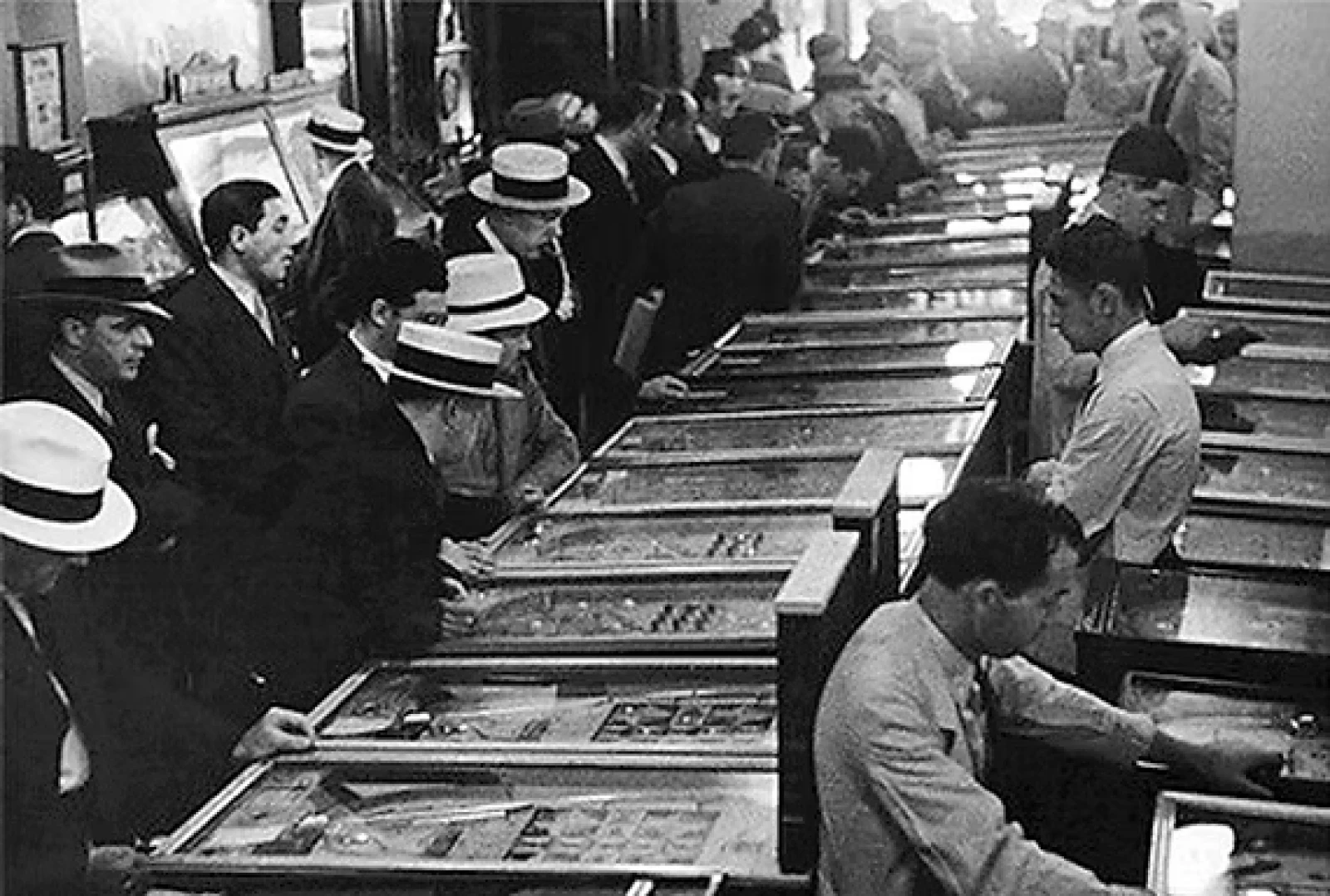
In the early years of the Great Depression, a pinball boom hit. Manufacturers turned to skill games as alternatives to slot machines, reviving the bagatelle format among others. Several independent makers would enter the field and find great success, including future industry kingpins David Gottlieb, Harry Williams, and Bally’s Ray Moloney. With relatively simple construction and low costs, manufacturers could easily build and sell the games to operators, who in turn could earn a profit on this form of cheap entertainment. With the Depression underway, consumers were seeking affordable entertainment and could find pinball just about anywhere they went.
PAYOUT GAMES
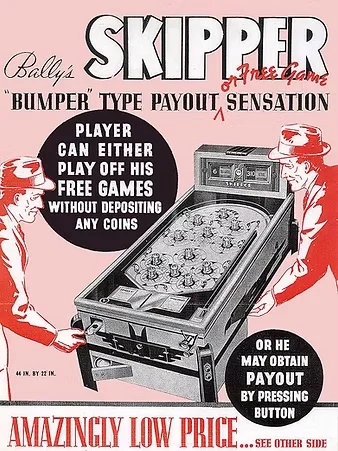
Competition in the burgeoning pinball industry escalated quickly, and some makers would take every opportunity to get an edge, up to and including outright copying of existing games. Beyond the patent infringements, industrious makers were dreaming up new features and promptly returned to cash payouts as a hook for their games. Despite their popularity (or perhaps due to it), these games would attract the same negative attention that damaged the slot machine industry a few decades before.
Though not all early pinball machines were gambling devices, the similarity between payout games and the slot machines that preceded them burnished an increasingly bad reputation in the public eye. Characterizing them as games of chance involving little or no skill, public officials and critics claimed pinball machines were operated under the
influence of organized crime syndicates and would lead to widespread gambling addictions and lives of crime. As bad press and public outcry gained momentum, pinball’s most famous opponent waged a public campaign to rid his city of the “insidious nickel-stealers” for good.
Fiorello LaGuardia ran for Mayor of New York City on a reformer platform dedicated to rooting out corruption, and following his 1934 election waged a very public war against slot machines and pinball. LaGuardia’s well publicized anti-pinball crusade through the 1930s helped spread the portrayal of pinball as a threat to morality and vulnerable communities. Though it would him take eight years to secure a pinball ban in New York City, other major US cities started enacting bans of their own in 1936, dealing a huge blow to the industry and tainting its reputation for decades to come.
In Los Angeles, pin games were under scrutiny as early as 1934. That year prosecutors charged cigar store clerk James Martin with 3 counts of possessing and operating a gambling device. In a courtroom scene strangely similar to Roger Sharpe’s famous testimony decades later, the defense called a star witness to demonstrate pinball was a game of skill. Characterized as “an expert marble shooter,” Lloyd Federmeyer would amaze jurors as he repeatedly called and made his shots, eliciting applause from the courtroom. Despite the skill he displayed, pinball in Los Angeles would ultimately be banned via voter referendum in 1939.
Around this time Harry Williams saw the threat payout games posed to the industry. A possible solution would come from a young assistant at Williams’ Automatic Amusements who invented a free play mechanism. Rather than being paid out by a bartender or attendant for skillful (or lucky) play, the game would automatically add a credit that a player could redeem by pushing in the coin slot. Avoiding cash payouts while retaining a player reward helped push pinball toward a more permissible legal status and further differentiate “novelty pinball” from payout games. Unfortunately, even free games were viewed as rewards of substantial value in some regions, and therefore remained prohibited.
Bans and public distrust slowed the pinball industry down, but the US entry into WWII would halt pinball production almost completely as the nation redirected resources toward the war effort. Manufacturers retooled factories to make military equipment, limiting their pinball output to the occasional re-themed or refurbished game. By the end of the war, many pinball makers had either gone out of business or faced an uphill battle against regulation. On the horizon however, an innovation would change the course of pinball history.
A GAME OF SKILL
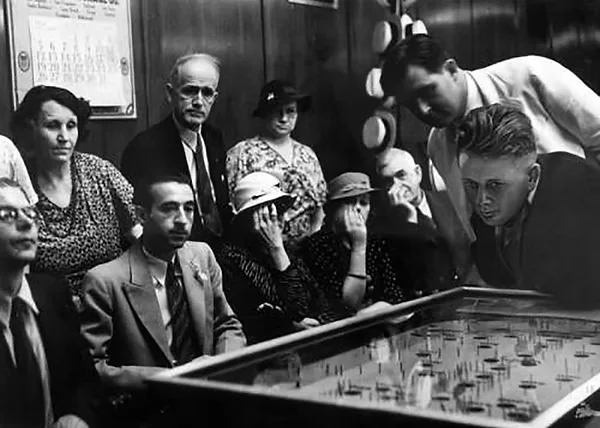
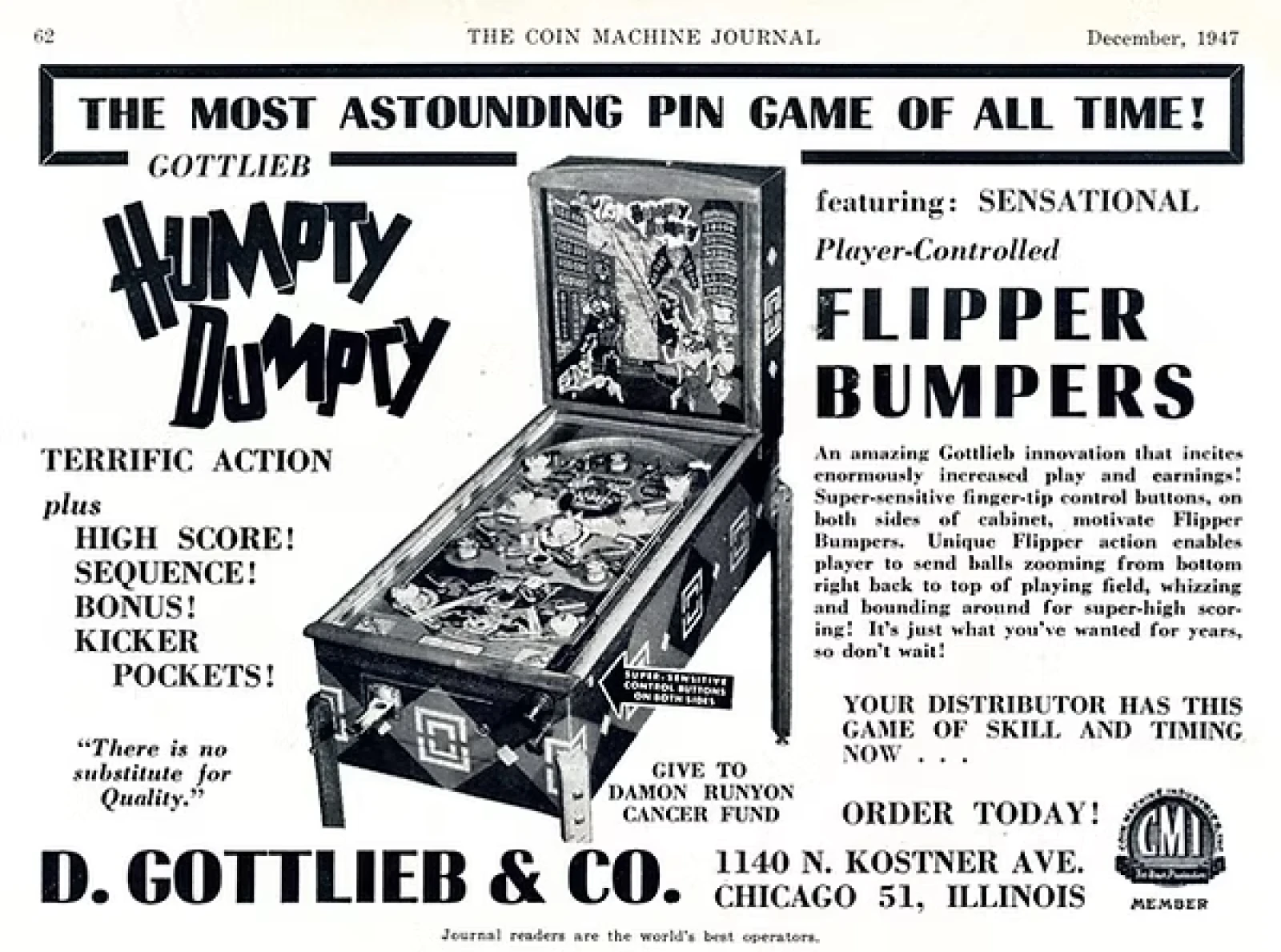
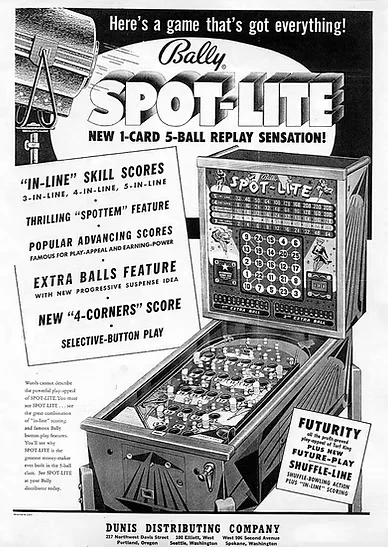
Two major sticking points kept pinball categorized as gambling machines: the delivery of rewards via cash payouts or prizes, and a perceived lack of skill required in play that made them mostly games of chance. Gottlieb countered the second point by introducing a substantial skill element with player operated flippers in 1947’s Humpty Dumpty. Prior to flippers, a player’s influence over the ball was mostly limited to skillshots via the plunger and nudging the machine as the ball traversed the playfield. The flipper gave rise to an entire category of pin games reliant on a player’s skill. However, not all manufacturers would immediately abandon the lucrative gambling sector in favor of skill games.
Of the big 3 pinball manufacturers, Gottlieb, Bally, and Williams, it was Bally that produced the most gambling-oriented games. The first to release an automatic payout pinball machine, Rocket in 1933, Bally had a foot in both sides of the coin operated industry throughout the company’s history. In addition to payouts, Bally made slot machines, horse racing games, and began releasing bingo machines in the 1950s. Though similar in design to a standard pinball machine, bingo games had no flippers and their playfields were arranged with holes that corresponded to a bingo card on the backglass. Players attempted to light numbers on the card that would award them either free plays or cash. Additionally, a player could add more coins at the start of play to increase the payout odds on certain combinations, sometimes with awards in the triple digits. Rather than playing off all those free games, the player could request a payout from the attendant for the equivalent value of the games. These machines quickly brought the spotlight back onto pinball as a form of gambling, and resulted in Federal decisions like the Johnson Act declaring them gambling devices.
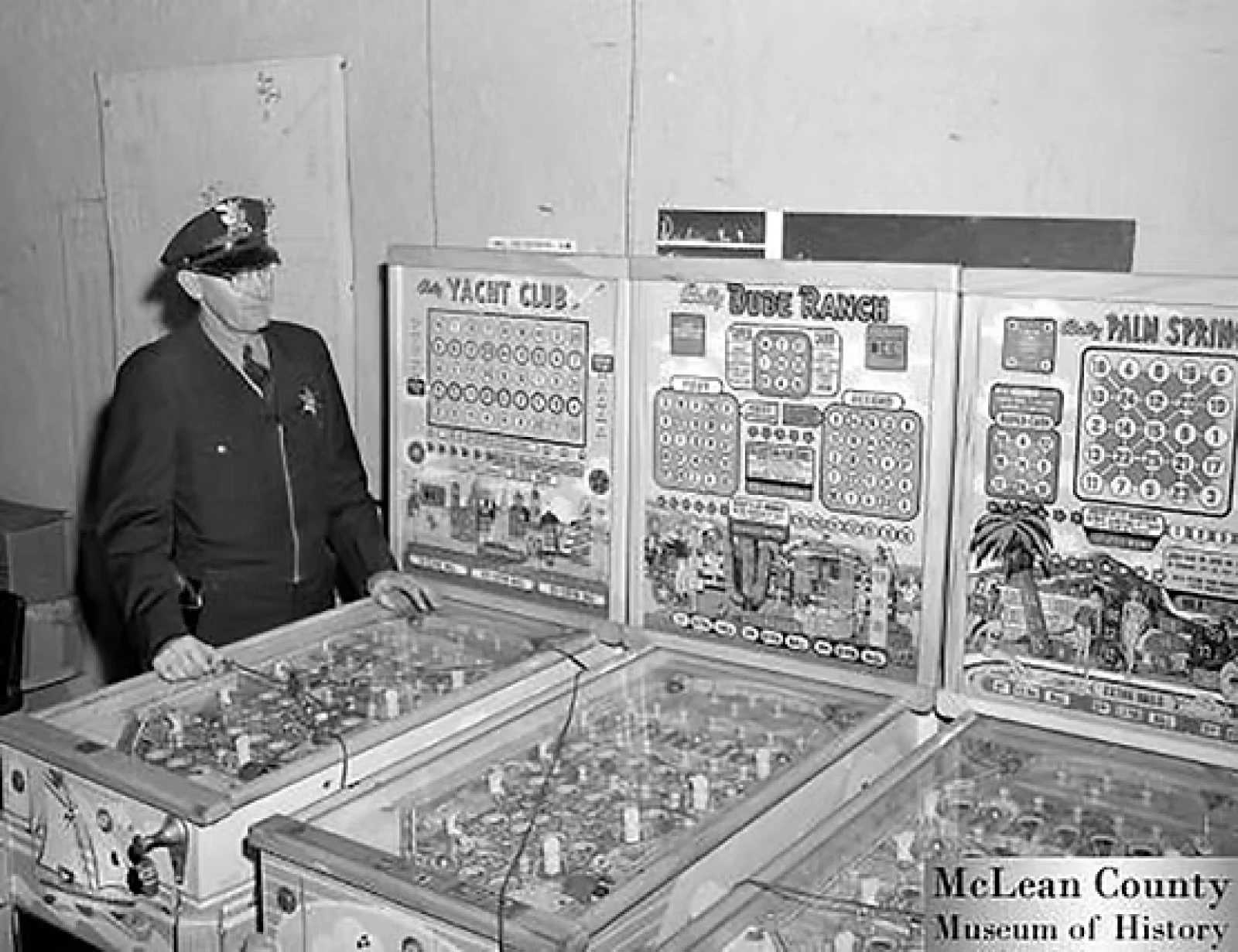
As regulation efforts progressed, there was considerable confusion among legislators, journalists and critics about the features and characteristics of games they were discussing. Though not technically illegal, amusement pinball games were vulnerable to seizure during raids because they looked similar to gambling machines and were often operated in the same places. Within the industry, some manufacturers attempted to distinguish their flipper games from the maligned gambling machines, marketing their own as “a game of skill” and “amusement pinballs”.
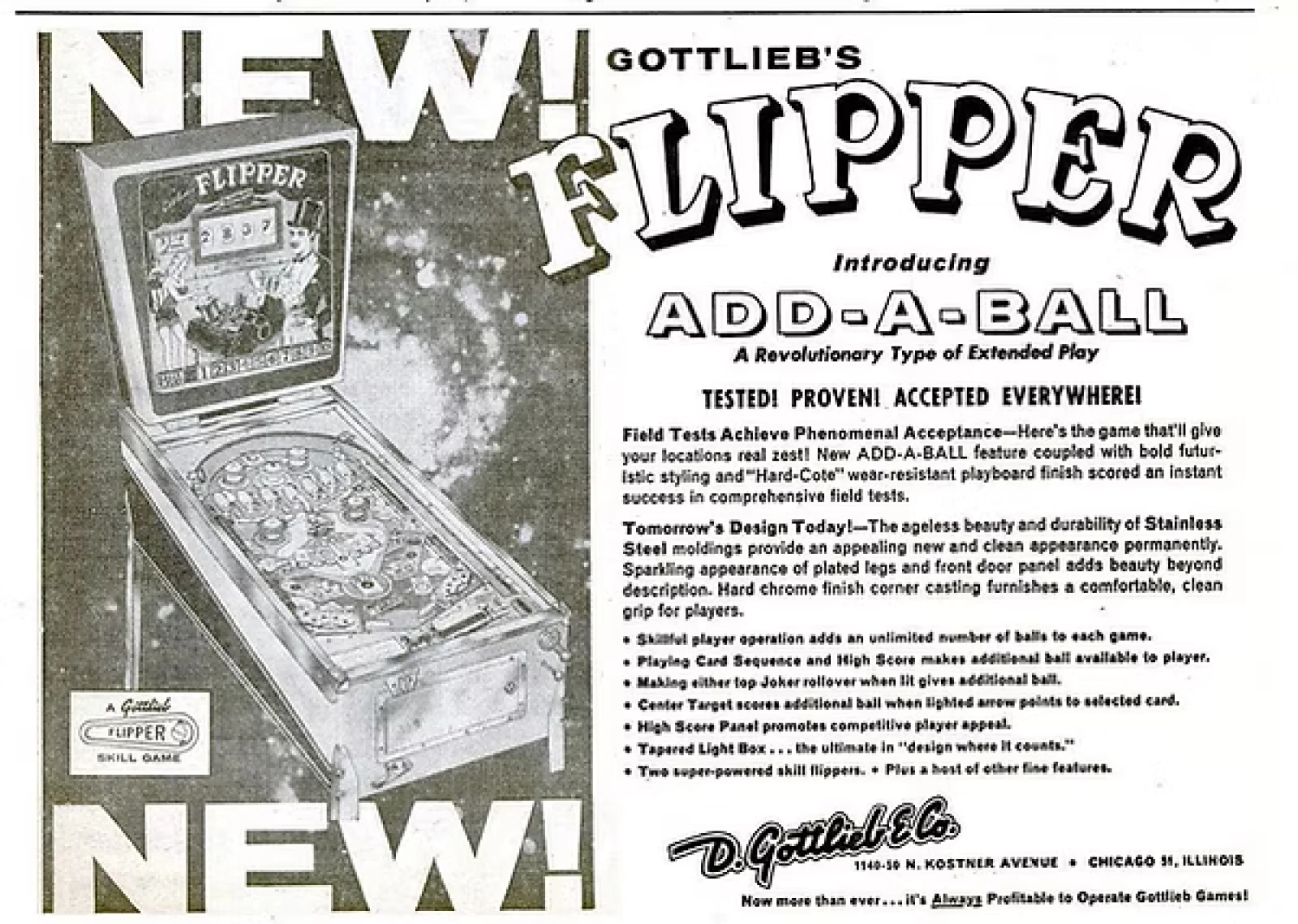
Bans would prove to be a persistent hurdle for pinball manufacturers, with localities displaying a spectrum of tolerance ranging from outright bans to limits on features a game could offer. The last significant design change aimed at legitimizing pinball came from Gottlieb in 1960. In areas where replay games were prohibited, demand for pinball remained high. To get around the bans, Gottlieb engineer Wayne Neyens created the first Add-a-Ball game. Instead of receiving a free game for skillful play, Add-a-Balls would prolong a player’s game by adding another ball to their game, essentially adding an extra turn. Gottlieb found great success with the feature, which opened up new markets for their games and was simple to incorporate with only small changes to artwork and assembly.
CHANGING CULTURE
Through the 1950’s and 60’s, American culture would undergo several changes that would fuel a new pinball boom. Suburban populations rapidly grew and the Baby Boom created an enormous youth culture, the most affluent in American history. Family amusement centers like bowling alleys and roller skating rinks popped up to entertain this new class of consumers, and would often include coin operated games. With customers possessing disposable income, leisure time, and increased access to games, the pinball industry started inching toward legitimacy in the eyes of the public.
Pinball’s popularity continued to steadily grow in the 1960s and 70s, while regulation and public opposition began to drop off. Revisions to the Johnson Act in 1962 clarified its scope specifically to payout pinball machines. A California Supreme Court decision in 1974 affirmed that flipper games did include an element of skill, distinct from the rudimentary marble games that the law was originally meant to curtail. This case paved the way for lifting bans in other parts of the country.
All of this leads up to the famous showdown between the NY City Council and Roger Sharpe in 1976. Sharpe, a journalist and top pinball player at the time, appeared before the council as a witness to demonstrate pinball as a game of skill. Through skillful play, and a little luck as Sharpe recalls, he convinced the council to legalize pinball in NYC after decades of prohibition. Chicago would follow suit the next year, and the pinball industry would approach its greatest peak since the 1930s.
Thanks to a renewed interest in pinball, it’s not uncommon to see news reports about pinball being legalized in a city or town in the 21st century. Usually it’s a long-forgotten and unenforced ordinance that gets discovered while investigating another issue. Oakland, CA found and overturned one such law in 2014; as of 2023 pinball was still technically illegal to play for anyone under 18 in South Carolina.
RESOURCES & FURTHER READING
Over the past few decades an entire field of study has grown around the history of video games and their impact on culture, often intersecting with pinball history. Pinball itself has a number of historians who’ve written about the history of the game. Thanks to the work of all of these scholars conducting interviews and research, we’re able to piece together a history that wouldn’t be easily obtained otherwise. This page is by no means an exhaustive or complete history of the subject, there are many outstanding books and websites exploring the topic in great detail. Below are some of the resources used in researching this article.
BOOKS
Bueschel, Richard. Encyclopedia of Pinball, Volume 1. Silverball Amusements, 1996
Horowitz, Ken. From Pinballs to Pixels: An Arcade History of Williams-Bally-Midway. North Carolina: McFarland & Company, 2023
Kocurek, Carly A. Coin-Operated Americans: Rebooting Boyhood at the Video Game Arcade. Minnesota: University of Minnesota Press, 2015
Sharpe, Roger C. Pinball! New York: E.P. Dutton, 1977
WEBSITES
Bingo.cdyn.com; Pingames and Gambling by Russ Jensen
Law.justia.com; Cossack v. City of Los Angeles
Pinballnews.com; Gambling, Pingames, & The Shifting Sands of Manufacturer Perspectives by Nicholas Baldridge, Steven Doellefeld, and Dennis Kriesel
Sbhistoryblog.wordpress.com; Pinball Wizards Sidelined by Gambling Enforcement Bans in the 1940s and 1950s by Sam Gnerre
Videogamehistorian.wordpress.com; Historical Interlude:The History of Coin-Op Parts 2-6 by Alexander Smith